
The Working Memory limit
We need to present new material in a way that works for how brains learn – and the limits of the brain. Let’s have a look at the Working Memory limit.
Working Memory is the space in the brain where we store thoughts and images for a few seconds, while we think about something.
It’s a function of the pre-frontal cortex of the brain, and it’s separate from long term, permanent memories.
It’s made up of two components:
- The auditory loop: where we repeat some words in our head.
- The visual-spatial sketchpad: where we store images we’re thinking of.

The Working Memory limit
We know that there is a range of 5-9 slots in working memory in the general adult population. The number of slots increases during childhood, reaching its maximum between 11 and 15 years of age.
Most adults are unaware of their own or other people’s limits. The majority of teachers are in the upper end of the scale, but their lower ability students may be at the lower end.
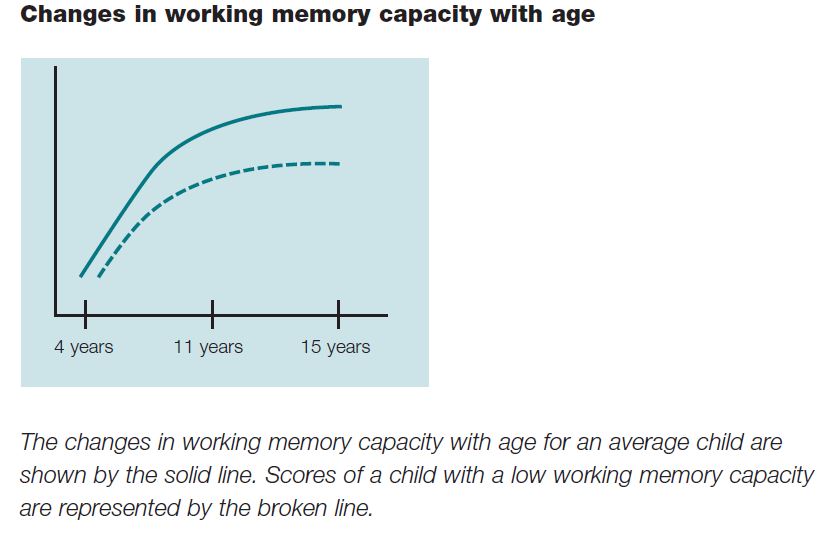
This means that it’s easy to overload our students’ Working Memory. Their response is either to fail to follow the instruction, or to lose interest – in the same way that we would lose interest if a speaker used a foreign or technical language we barely knew.
Here’s a video that shows the effect on a student of being given too much information at once.
Here are some teaching tips, taking into account the Working Memory limit
 Present new material in short chunks.
Only introduce a few things at a time – bear in mind that the limit is around 5-9 slots. It’s a good idea to use fewer chunks for students who are younger or are less able.
Think about the language you’re using.
Use short sentences, and use language that the students already know.
Make it multi-sensory.
The auditory Working Memory and the visual Working Memory are separate, so use both words and images to make the most of this.
Simplify if the student doesn’t understand.
If the student isn’t understanding the new material, try presenting only half of the material and then checking for understanding.

What does the research say?
There’s some great information in Principles of Instruction (by Barak Rosenshine) on how to teach in a way that deals with the Working Memory limit. Rosenshine emphasises how important it is not to overwhelm our students with too much information at once.
He describes the same process we have talked about here:
- Present small amounts of new material at a time.
- Spend time helping students to practise the material.
- When the students have mastered it, then move onto the next step.
Rosenshine says that this process takes time. For example, he found that the most effective maths teachers spent over half of the lesson introducing new material with worked examples and questioning. The extra time is worth it – there’s a higher success rate, and the material doesn’t need explaining again.

There are different ways to do this. One way is to give a series of short presentations with lots of examples. Another way would be to follow this process, in this case to teach a strategy for summarising a paragraph:
- Model and think aloud as you identify the topic of a paragraph.
- Lead practise on identifying the topic of paragraphs.
- Teach students to identify the main idea of a paragraph.
- Model how to identify the main idea of a paragraph.
- Supervise the students as they practise these parts.
- Teach the students to identify the supporting details in a paragraph, modelling and thinking aloud.
- Give the students opportunities to practise.
- The students then practise the whole strategy.
Image credits
Header image: http://www.schools4health.com/for-parents/
Brain image: http://www.ox.ac.uk/news/2015-06-05-workings-working-memory-revealed
Brick wall image: http://www.diy-tips.co.uk/how-to-build-a-wall/
Stepping stones image: http://blog.prepscholar.com/how-to-write-an-sat-essay-step-by-step