
Growth mindset
Explanation: Developing a growth mindset in your classroom supports effective learning.
The concept of mindset was originally proposed by Prof. Carol Dweck. She wrote that mindset comes in two flavours: fixed or growth.
The type of mindset you have contributes to what you believe about yourself, how you view your abilities, and how you perceive your achievements.
Fixed mindset: A belief that you have a set number of skills and abilities, and that you only have the potential to achieve up to a certain limit. Students with a fixed mindset are only willing to try activities or tasks that validate their current knowledge.
Growth mindset: A belief that you can improve your own abilities through dedication, practice and learning, and that you have the potential for significant achievement.
Evidence: what does it say about Mindset?
Your classroom as a learning environment has a significant impact on student behaviour and achievement (according to research by Young et al 2016). A large part of that environment is you as the teacher (Wirth 2016).
A teacher with a fixed mindset projects this onto the students and this impacts how effectively they learn. It’s important to review your own mindset as a starting point, as well as setting high expectations to inspire and motivate your students.
Promoting a growth mindset within a student creates a desire to approach more difficult tasks to improve their knowledge. This helps the student to develop a more positive relationship with learning, which will enable more effective learning. It also enables students to develop more confidence in themselves, and it promotes a growth mindset (Wyatt 2016).
There are many others who have written on the concept of growth mindset, such as Angela Lee Duckworth who uses the term ‘grit’.
Marzano’s research refers to growth mindset as “reinforcing effort and providing recognition”, and gives it an effect size of 0.7.
Changing Mindsets. A recent study by the Educational Endowment Foundation showed that the process of changing mindsets is a long-term project. In the study, students were given growth mindset training for six weeks by trained teachers. This showed an effect size of only 0.18.
Consequently, a whole-school, long-term approach is the only one which is likely to be effective.
So far we’ve already quoted research from Prof. Carol Dweck, Young, Wirth, and Wyatt. There are many others who have written on the concept of growth mindset, such as Angela Lee Duckworth who uses the term ‘grit’.
Marzano’s research refers to growth mindset as “reinforcing effort and providing recognition”, and gives it an effect size of 0.7. Here is a video with more information about Marzano’s take on growth mindset.
Anecdote
Dawn used to work for a company where staff weren’t allowed to be negative. When she started, she thought: “Who are you to tell me that I can’t be negative?”. However, she was amazed at how different attitudes were in the office, and how it uplifted your mood.
In management training, the focus was on solving solutions, rather than just talking about problems. This encouraged people to take responsibility for problem-solving, rather than just coming to managers to complain about a problem and expecting the manager to fix it for them.
Application
Use growth mindset language
The language we use as teachers has a big effect on how students see themselves and their abilities.
You can shift from a fixed mindset by praising qualities like effort or application, rather than ability. This emphasises the hard work the student has put into a task, rather than focusing on achievement.
This approach means that every outcome can be rewarded with a positive response, regardless of achievement. Praising self-belief fosters and encourages a growth mindset.
Anecdote
Helen teaches older students in their late twenties. These students often have an ingrained beliefs about why they didn’t achieve well at school. Helen has introduced rules like using the word ‘yet’. Instead of “I can’t do this!”, students should say “I can’t do this yet”.
We can use words like:
- Yet
- At the moment
- Right now
- This week.
This shift in language encourages a growth mindset, where students see that their abilities can change with effort.
Activity: Talk about growth mindset
Try out the activity below with your students to start a discussion about how someone develops their skills and achieves in something.

Activity 1: Promoting a growth mindset
This activity is most effective when you do it in a group. You can do this with your students, or you can do this with your teacher colleagues.
First complete this short questionnaire for yourself:
- Name one thing which you’re good at outside of work/ school.
- What did you have to do to get good at it?
- What things did you need? Eg. Equipment, books.
- Did you need any help?
In your group, share and discuss your answers.
There are usually a wide range of answers for Q1, with varying answers for Q3 and Q4 depending on what was written in the first box.
However, the answers for Q2 are generally the same: practise and perseverance. We usually accept that our skills need to be practised and developed, but in the classroom we sometimes forget this and make judgements about our students’ intelligence as a fixed quality.
If you do this with your students, you could have a discussion about how someone develops their skills with something like applying make-up or fixing a motorbike. You could then discuss how they can develop their skills and achieve on your course. The aim is to encourage students to see that effort is the key.

Share examples of growth mindset
When you return marked work, keep one really good example. Check with the student before you share it with the class.
Read out or show the work to the class, and explain that you are sharing it because it is an excellent example. Ask the student: “Can you tell us how you did this?”. The students will almost invariably talk about the effort and hard work they put it: looking on the internet, asking a family member or friend, reading a book, and so on.
In a practical class, you might ask a student: “You’re really good at this hair cut Becky – what did you do to get so good at it?”. The student will then share with the class a process of practising on friends and family members, watching videos online, and so on.
These techniques gradually build the idea that skill and achievement doesn’t happen automatically, but rather happens through time and effort.

See three before me (C3B4ME)
This technique is from Dylan William, who is behind Assessment for Learning. He insists that his students ask three other people before they ask the teacher.
This encourages the idea that students should try and find out information themselves, and that their learning is their own responsibility.
Hand back responsibility to your students
A common situation is for a student to complain that they didn’t understand an assignment: “You didn’t explain it right!”. This might make us feel like it’s our fault, and we try to explain it again.
However, creating a growth mindset means that we should challenge our students. We might guide the student through a series of things that they could have done to understand the task themselves – they could have asked the teacher when the task was set, they could have asked a friend, and so on.
This sort of discussion changes the culture to one where students see the link between effort and results. In other words, this helps to develop a growth mindset.

Anecdote
When Peter first read about growth mindset, he decided to test the idea on his Year 11 middle/ upper ability group. He set a task and then stood back to see who had started, instead of moving round the motivate those who hadn’t started. He was looking for effort, rather than achievement.
He realised he’d made a significant error of judgement. He’d labelled some students as ‘clever’, but he saw that the students who did well were actually those who were working hard.
Additional materials and further reading
For further reading on growth mindset, have a look at:
.
- Even geniuses work hard: An article by Prof. Carol Dweck.
- Revisiting the growth mindset: by Prof. Carol Dweck.
- Teaching: Leading Learning: a blog article and infographic on mindset, which draws on some interesting sources.

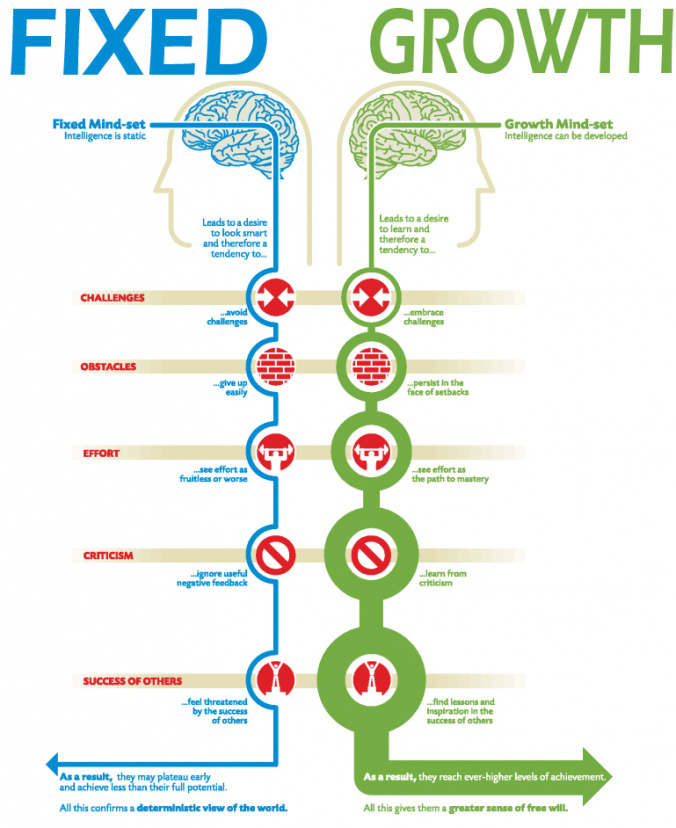
Image credits
- Header image: https://twitter.com/Orangefield_ISD/status/855491153470291968
- nfographic: https://chrishildrew.wordpress.com/2014/03/21/becoming-a-growth-mindset-school/
- rowth mindset image: https://www.edutopia.org/blog/growth-mindset-common-core-math-cindy-bryant
- rowth mindset statements image: http://natecooper.co/2016/08/territorial-versus-action-mindset/10-growth-mindset-statements/
- mall group discussion image: https://www.jesuitnola.org/co-curriculars/co-curricular-galleries/st-francis-borgia-leadership-institute-workshop-july-31-2013-2/
- hole class discussion image: http://cobbcast.cobbk12.org/?p=2245
- rowth mindset tree image: https://biglifejournal.com/blogs/blog/growth-mindset-resources