
Linking concrete and abstract ideas
When presenting new material, we can link abstract ideas with concrete experiences.
Students struggle with abstract ideas the most, so we need to be aware of the difference between concrete and abstract ideas in our subject.
The brain has no way to deal with abstract ideas other than by linking them (by analogy) with concrete experiences.
If we try to teach an abstract idea to someone who has no concrete experience to link to, the learning will fail.

Concrete or abstract?
Concrete ideas can be directly experienced or described.
Abstract ideas cannot be directly experienced and tend to answer How? or Why? questions.
Here are three ways to identify whether something is abstract or concrete:
.
- Can you show a picture of it?
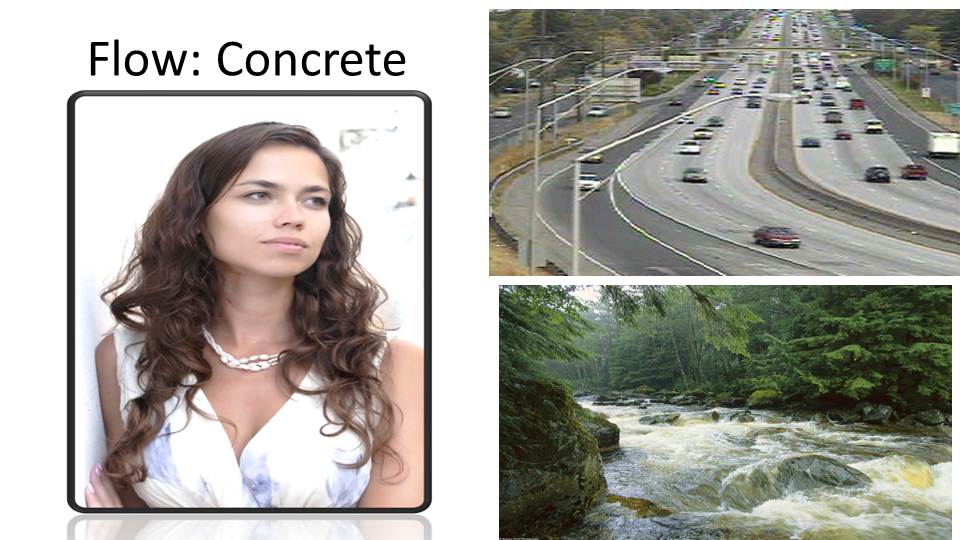
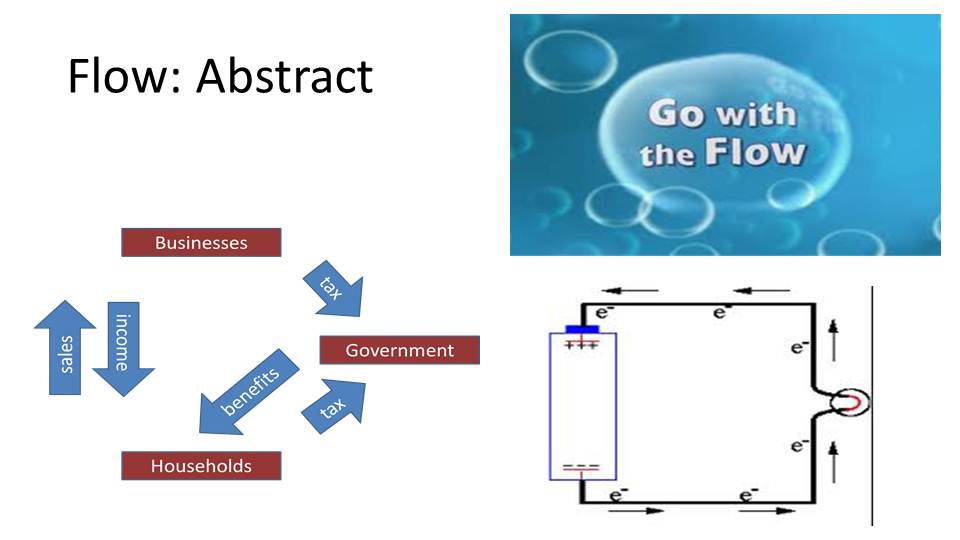
In the first example below, ‘flow’ is used in a concrete way in the top slide: flowing water, traffic, and hair. In the second example below, ‘flow’ is used in an abstract way: the flow of money, electricity, or someone who goes with the flow. We can’t take a picture of these abstract meanings.
2. Ask: “Which concepts do the more able students understand fairly quickly, but the less able students struggle with however
many times I explain it?”.
3. Does it answer the questions Who? When? and Where?
Concrete ideas often answer these questions – they are simple facts which can be observed. Abstract ideas often answer questions like How? or Why?.
Concrete and pictorial
Pictorial steps help our students to make links.
For example, we might get our students to start with doing arithmetic with actual paper cups, and then with circles which represent the cups. During this process, we can introduce the symbols 3, +, =, and so on.
Far too many students start secondary school without these strong links to concrete experiences, which means that maths feels like a parallel universe to them!

Is abstract thinking a stage?
Some people claim that students make a transition from concrete to abstract thinking during their teens, following Piaget’s ideas about formal thinking. However, recent research doesn’t support this – even young children can have some abstract thinking.
As teachers, we regularly see pupils who seem to have made a significant step in their ability over a short period of time.
One way to explain this is to think of a difficult thinking task as being similar to lifting a weight. As the child grows they remain unable to lift the weight until one day they can. After that date they can always lift the weight. Their strength has grown steadily, but what we observe is a sudden improvement.

Brain explanation
Two of the most important components in ‘intelligence’ are:
- Working Memory capacity.
- Secure prior knowledge.
Working memory capacity improves in childhood, reaching adult level at around 14 years of age (although the range is huge). The research shows that the most able students at a given birth age can be four years in advance of the average.
If a particular student has insufficient Working Memory and/ or insufficient prior knowledge, then understanding an abstract concept may be impossible until it is either simplified or the missing knowledge is filled in.

Image credits
Header image: http://www.timesofisrael.com/topic/bagrut/
Thought bubble image: http://copywritinginaction.com.au/concrete-abstract/
Maths with cups image: https://www.education.com/activity/article/Counting_Cups/
Children with weights image: http://www.npr.org/sections/health-shots/2012/09/25/158652017/is-crossfit-training-good-for-kids