
Self and peer feedback
Peer and self-assessment are excellent strategies for Step 4: Feedback.
Not all feedback needs to come from the teacher: students can assess their own work and their peers’ work.
One way that students might self-assess is by marking their own work from the mark scheme. The process of marking their own work helps to correct wrong links, reinforce correct links, and approach the learning in a different way.
A similar effect happens when students mark someone else’s work. They need to decide if each answer is correct, and if not, what the correct answer should be.
Both activities are a form of repetition, which exercises the developing brain pathways and reinforces the creation of long term memories.

What does the research say?
The evidence shows that self and peer feedback are highly effective strategies.
Below is a video clip of Dylan Wiliam talking about peer and self-assessment. Dylan Wiliam is an expert in the field of education and is well respected for his work on Assessment for Learning and formative assessment.
In the clip, Dylan Wiliam explains the research findings which show that peer and self-assessment are not only useful in summative assessment, but even more so in formative assessment (see here for more on summative and formative assessment). This is because both students benefit from the process.
Self-assessment
The effectiveness of self-assessment is demonstrated by the following experiment.
- Students are taught the same topic in the same way and given the same test. They are then divided into two groups.
- The Group 1 students have their work marked by the teacher who gives them a mark.
- The Group 2 students are given the mark scheme to mark their own work.
- The evidence shows that the Group 1 students tend to just look at the mark and have an emotional response, but the Group 2 students engage with the material and get an extra repetition of the new learning.
- The students are tested again a few weeks later. The Group 2 students score more highly than the Group 1 students.
You might be wondering whether self-assessment really works in practice: what if the students cheat, or what if they aren’t accurate? The evidence suggests that these risks are worth taking. In any case, any cheating is far less than expected, and still serves to reinforce the new learning.
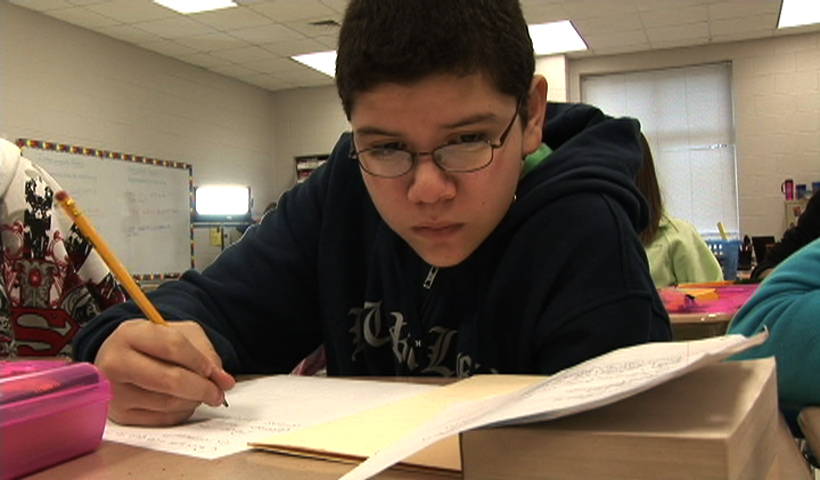
Peer assessment
Peer assessment has similar benefits to self-assessment and works in a similar way. The difference is that the students have to work harder to decide if the answer is correct.
The video clip below shows the use of peer assessment in a primary maths class. The students have completed a task using pictograms (graphical representations to show data). They are now going to assess another group’s work using the success criteria they were given at the beginning of the lesson.
Image credits
Header image: https://www.edutopia.org/discussion/talking-learn-harnessing-power-student-conversation
Image of students working together: https://autodo.info/pages/m/middle-school-kids-working-together/
Image of a student working independently: http://www.learnnc.org/lp/multimedia/15586